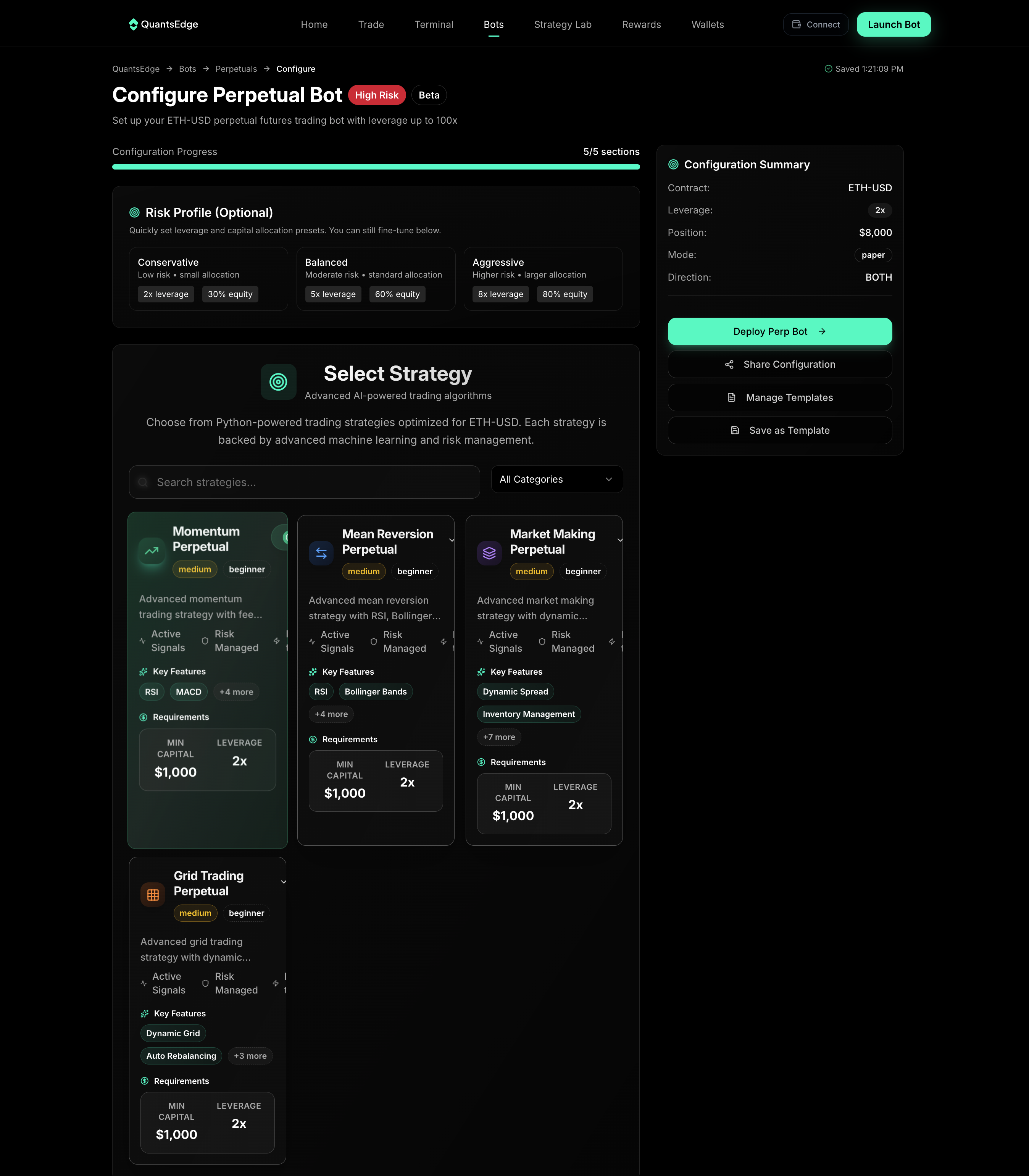
> For the complete documentation index, see [llms.txt](https://quantsedge.gitbook.io/quantsedge-docs/llms.txt). Markdown versions of documentation pages are available by appending `.md` to page URLs; this page is available as [Markdown](https://quantsedge.gitbook.io/quantsedge-docs/trading-strategies/strategy-overview.md).
# Strategy Overview
Choose the right trading strategy based on current market conditions and your risk tolerance.
## Strategy Categories
### Momentum Trading
Advanced momentum trading strategy with fee optimization and comprehensive risk management.
**Concept:** "The trend is your friend" - ride existing directional moves with intelligent entry/exit timing
| Attribute | Details |
| ------------------ | -------------------------------------------------------------------- |
| **Best Markets** | Clear trends, strong momentum, breakouts |
| **Risk Level** | Medium-High |
| **Skill Required** | Intermediate-Advanced |
| **Timeframe** | Hours to days |
| **Key Features** | RSI, MACD, Moving Averages, Fee Optimization, Overtrading Prevention |
[Learn More →](/quantsedge-docs/trading-strategies/strategy-momentum.md)
### Mean Reversion
Advanced mean reversion strategy with RSI, Bollinger Bands, and intelligent range detection.
**Concept:** "What goes up must come down" - trade against extremes with sophisticated range detection
| Attribute | Details |
| ------------------ | ------------------------------------------------------------------------ |
| **Best Markets** | Range-bound, sideways, low volatility |
| **Risk Level** | Low-Medium |
| **Skill Required** | Intermediate-Advanced |
| **Timeframe** | Minutes to hours |
| **Key Features** | RSI, Bollinger Bands, Range Detection, Fee Optimization, Trend Avoidance |
[Learn More →](/quantsedge-docs/trading-strategies/strategy-mean-reversion.md)
### Market Making
Advanced market making strategy with dynamic spread management and sophisticated inventory control.
**Concept:** "Provide liquidity" - profit from bid-ask spreads while managing inventory risk
| Attribute | Details |
| ------------------ | ---------------------------------------------------------------------------- |
| **Best Markets** | High-volume, liquid markets with consistent spreads |
| **Risk Level** | Medium |
| **Skill Required** | Advanced |
| **Timeframe** | Minutes to hours |
| **Key Features** | Dynamic Spread, Inventory Management, Volatility Adjustment, Grid Management |
### Grid Trading
Systematic grid trading strategy with dynamic level adjustment and risk management.
**Concept:** "Buy low, sell high" - systematic profit from price oscillations
| Attribute | Details |
| ------------------ | ----------------------------------------------------------- |
| **Best Markets** | Range-bound, oscillating markets |
| **Risk Level** | Medium |
| **Skill Required** | Intermediate-Advanced |
| **Timeframe** | Hours to days |
| **Key Features** | Dynamic Grid Levels, Risk Management, Volatility Adjustment |
### Breakout Trading
Catch explosive moves when price breaks key levels.
**Concept:** "Buy strength" - enter when price breaks consolidation
| Attribute | Details |
| ------------------ | -------------------------------------------------- |
| **Best Markets** | Consolidating ranges, high volatility, news-driven |
| **Risk Level** | Medium-High |
| **Skill Required** | Intermediate |
| **Timeframe** | Hours to days |
[Learn More →](/quantsedge-docs/trading-strategies/strategy-breakout.md)
## Strategy Comparison
| Strategy | Win Rate | Avg Win | Avg Loss | Best Market |
| ------------------ | -------- | ---------- | -------- | ----------- |
| **Momentum** | 40-50% | Large | Medium | Trending |
| **Mean Reversion** | 60-70% | Small | Small | Range-bound |
| **Breakout** | 35-45% | Very Large | Medium | Volatile |
## Choosing Your Strategy
### Match to Market Conditions
**Trending Market (ADX >25):**
* Use: Momentum, Breakout
* Avoid: Mean Reversion
**Range-bound Market (ADX <20):**
* Use: Mean Reversion
* Avoid: Momentum, Breakout
**High Volatility (VIX >30):**
* Use: Breakout, Mean Reversion (shorter timeframes)
* Reduce: Position sizes across all strategies
### Match to Risk Tolerance
**Conservative:**
* Primary: Mean Reversion
* Position size: 1-2% risk per trade
* Leverage: 1-2x maximum
**Moderate:**
* Mix: 50% Mean Reversion, 30% Momentum, 20% Breakout
* Position size: 2-3% risk per trade
* Leverage: 2-5x
**Aggressive:**
* Primary: Momentum, Breakout
* Position size: 3-5% risk per trade
* Leverage: 5-10x
## Building a Strategy Portfolio
**Diversification benefits:**
* Reduces overall portfolio volatility
* Captures opportunities across market conditions
* Lowers correlation risk
**Sample portfolios:**
**Beginner (1-2 strategies):**
* 70% Mean Reversion
* 30% Momentum
**Intermediate (2-3 strategies):**
* 40% Mean Reversion
* 40% Momentum
* 20% Breakout
**Advanced (3-4 strategies):**
* 30% Mean Reversion
* 30% Momentum
* 30% Breakout
* 10% Custom/Experimental
## Common Mistakes
**Over-complexity:** Too many indicators and rules **Solution:** 2-3 clear rules work better
**Ignoring market regime:** Using same strategy in all conditions **Solution:** Match strategy to current market
**No stop losses:** Hoping losing trades reverse **Solution:** Always use stops, accept small losses
**Curve fitting:** Optimizing until backtest perfect **Solution:** Prefer logical strategies, accept imperfect backtests
## Strategy Performance Metrics
**Key metrics to track:**
| Metric | Good | Excellent | Purpose |
| ------------- | ---- | --------- | ---------------------- |
| Win Rate | >45% | >60% | Consistency measure |
| Profit Factor | >1.3 | >1.8 | Risk/reward efficiency |
| Sharpe Ratio | >1.0 | >2.0 | Risk-adjusted returns |
| Max Drawdown | <20% | <10% | Downside protection |
## Getting Started
**Start with templates:**
* Use pre-built strategies
* Learn platform mechanics
* Understand strategy behavior
**Test thoroughly:**
* Backtest 3-6 months minimum
* Paper trade 5-7 days
* Start live with small positions
**Monitor and adapt:**
* Track performance vs benchmarks
* Adjust to changing markets
* Rotate underperforming strategies
***
**Choose strategies that match your style and market conditions.** No single strategy works in all markets - diversify and adapt.
**Next:** [Create Your First Bot](/quantsedge-docs/getting-started/first-trading-bot.md) | [Momentum Strategies](/quantsedge-docs/trading-strategies/strategy-momentum.md) | [Mean Reversion](/quantsedge-docs/trading-strategies/strategy-mean-reversion.md)
---
# Agent Instructions
This documentation is published with GitBook. GitBook is the documentation platform designed so that both humans and AI agents can read, navigate, and reason over technical content effectively. Learn more at gitbook.com.
## Querying This Documentation
If you need additional information that is not directly available in this page, you can query the documentation dynamically by asking a question.
Perform an HTTP GET request on the current page URL with the `ask` query parameter, and the optional `goal` query parameter:
```
GET https://quantsedge.gitbook.io/quantsedge-docs/trading-strategies/strategy-overview.md?ask=&goal=
```
`ask` is the immediate question: it should be specific, self-contained, and written in natural language.
`goal` is optional and describes the broader end goal you are ultimately trying to accomplish on behalf of the user. GitBook uses it to tailor the answer towards what is most useful for that goal.
The response will contain a direct answer to the question and relevant excerpts and sources from the documentation.
Use this mechanism when the answer is not explicitly present in the current page, you need clarification or additional context, or you want to retrieve related documentation sections.